
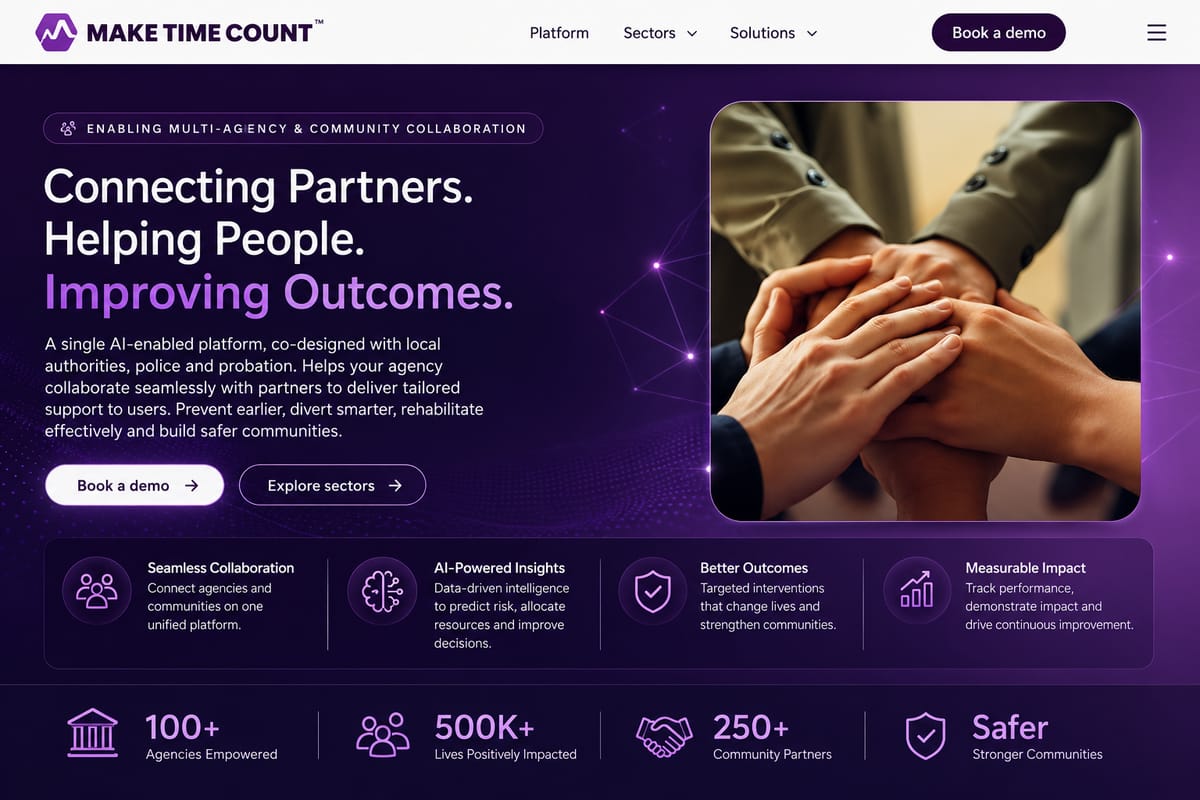
Government
Make Time Count
An AI-based platform for public services
Key outcomes
- Brought several organisations together onto one shared system
- Reduced the need to switch between different tools by bringing the work into a single system
- Kept a carefully governed public project running to plan
The problem
Helping people rebuild their lives after prison involves a lot of different groups: the police, probation officers, local councils, and community support organisations. The trouble was that none of them shared the same information. Details about a person’s case were scattered around, everyone worked slowly because they could not see the full picture, and the people who needed help most were often the last to get it.
The idea was to build one platform, with some help from AI, where all of these groups could work on the same cases together.
What I did
- Found out what everyone needed and wrote it all down. I sat with people from very different organisations, each with their own way of working, and turned their needs into one clear, shared plan.
- Turned vague “add some AI” requests into real features the team could build. Saying “the platform should use AI” is easy; my job was to work out exactly what that meant in practice, and make sure it was something we could build, test, and that everyone, including people with disabilities, could actually use.
- Ran the testing with the client, checking alongside the users and the build team that what we had made really did what the services needed.
- Stayed close to the developers, testers, and designers the whole way through, so questions got answered as they came up instead of piling up at the end.
Why it was tricky
Government groups, AI features, and making everything usable for people with disabilities are each hard on their own. This project had all three at once. Every requirement had to be clear enough for the engineers, simple enough for non-technical staff to follow, and had to meet the accessibility standards public services are held to.
How it turned out
The platform went live at maketimecount.today, giving the police, probation officers, local councils, and support groups one shared place to manage cases and support people. It remains one of the projects I am most proud of, because the people using it are real people trying to turn their lives around.
A sample of my work
Illustrative only. It contains no confidential client information.Delivery plan
The step by step plan for bringing several organisations onto a single, well managed system.
-
Research
Weeks 1 to 3- Review the existing tools
- Agree what the single system should cover
-
Building
Weeks 4 to 10- Build the main system
- Move the shared information across
-
Bringing organisations on
Weeks 11 to 14 In progress- Move each organisation onto the single system
- Provide training and written guidance
-
Launch
Week 15- Switch over to the new system
- Obtain formal approval
-
Support and improvement
Week 16 onwards- Provide close support after the launch
- Review what went well and what could be improved
A sample of my work
Illustrative only. It contains no confidential client information.Budget management plan
How I planned, tracked and kept control of the budget on a publicly funded project. The figures below are illustrative.
- Total budget
- £120,000
- Spent to date
- £72,000
- Remaining
- £48,000
- Budget used
- 60%
How to read this: Remaining is the budget minus what has been spent. Used is the amount spent as a share of the budget. The figures are illustrative.
| Category | Budget | Spent | Remaining | Used | Status |
|---|---|---|---|---|---|
| Development | £54,000 | £36,000 | £18,000 | 67% | On track |
| Testing and quality | £18,000 | £7,000 | £11,000 | 39% | On track |
| Project management | £18,000 | £11,000 | £7,000 | 61% | On track |
| Design | £12,000 | £10,000 | £2,000 | 83% | On track |
| Setup and running costs | £12,000 | £6,000 | £6,000 | 50% | On track |
| Contingency reserve | £6,000 | £2,000 | £4,000 | 33% | At risk |
| Total | £120,000 | £72,000 | £48,000 | 60% |
How the budget is controlled
- Reporting
- Spending is reviewed and reported every two weeks.
- Approval
- Any spending above the agreed limit needs the client to approve it first.
- Change control
- Any change to the scope is costed and agreed before the work starts.
- Contingency
- A small reserve is kept for unexpected work and released only when needed.